Curved stone patio in Berkhamsted
Natural stone terracing that steps down from the house on a curve, every level edged in brick-on-edge, with brick banding fanned through the paving and curved retaining walls holding the beds back.
- Where
- Berkhamsted, Hertfordshire
- Work
- Decoration & finishing
- Photographs
- 3 from the job
A garden that fell away from the house
The ground here dropped away from the back of the house, which is the situation that turns a patio into a piece of building work. You can either fight the slope with one big retaining wall and a single flat platform, or you can go down it in stages and let the garden keep its shape. This one goes down in stages, and it does it on a curve.
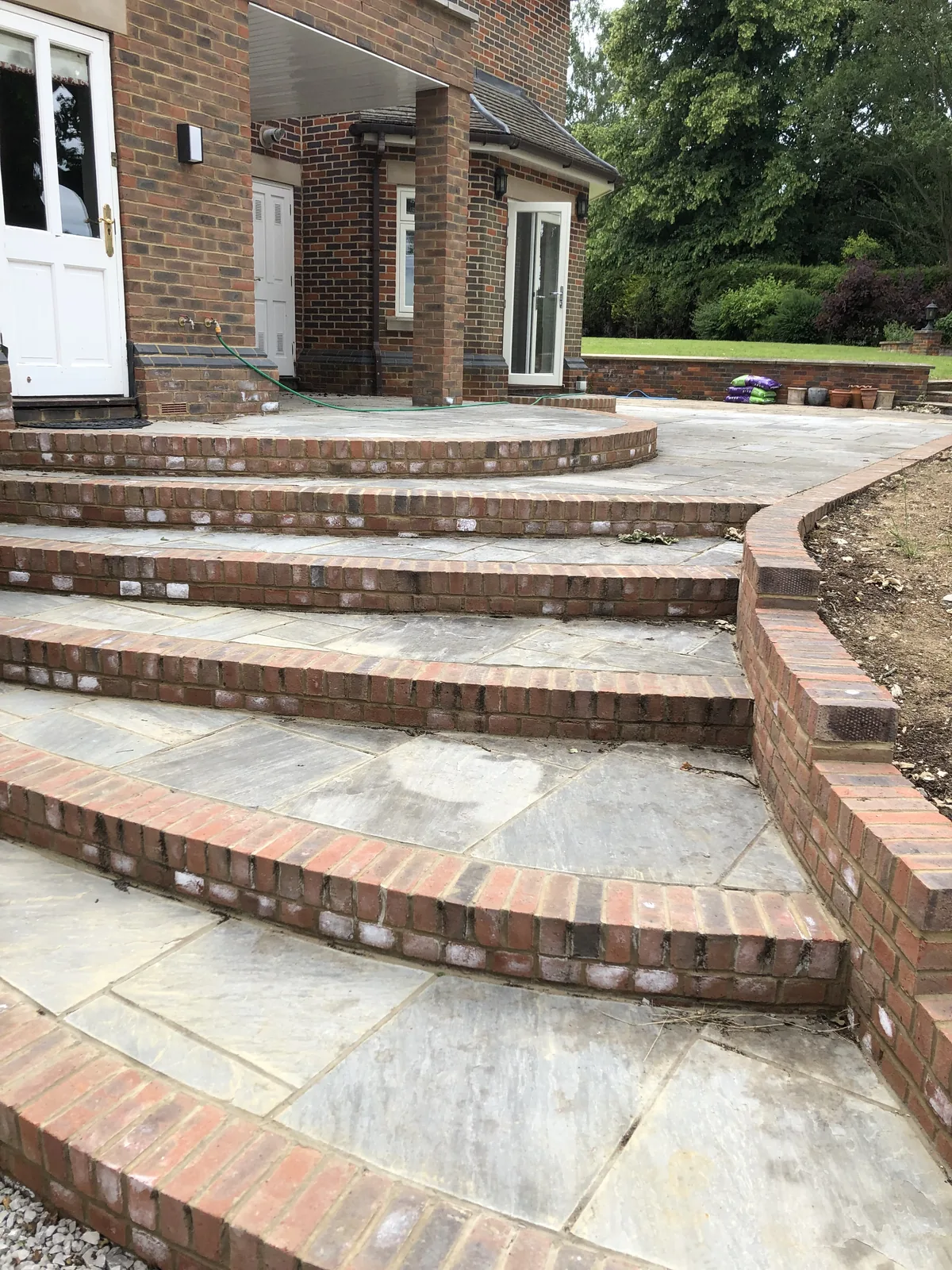
Four levels step away from the door, each one edged with a brick-on-edge riser, with a curved brick wall holding the border back along one side. Nothing here is square to the house, and that is the whole design.
Curves are a bricklaying problem, not a drawing problem
A curve is easy to draw and awkward to build. Bricks are straight and stone comes in rectangles, so every sweep on this job is made of short straight pieces set to a radius and jointed so that the eye reads a curve instead of a series of corners. There is no trick to it — it is set out on the ground, adjusted by eye, and laid slowly.
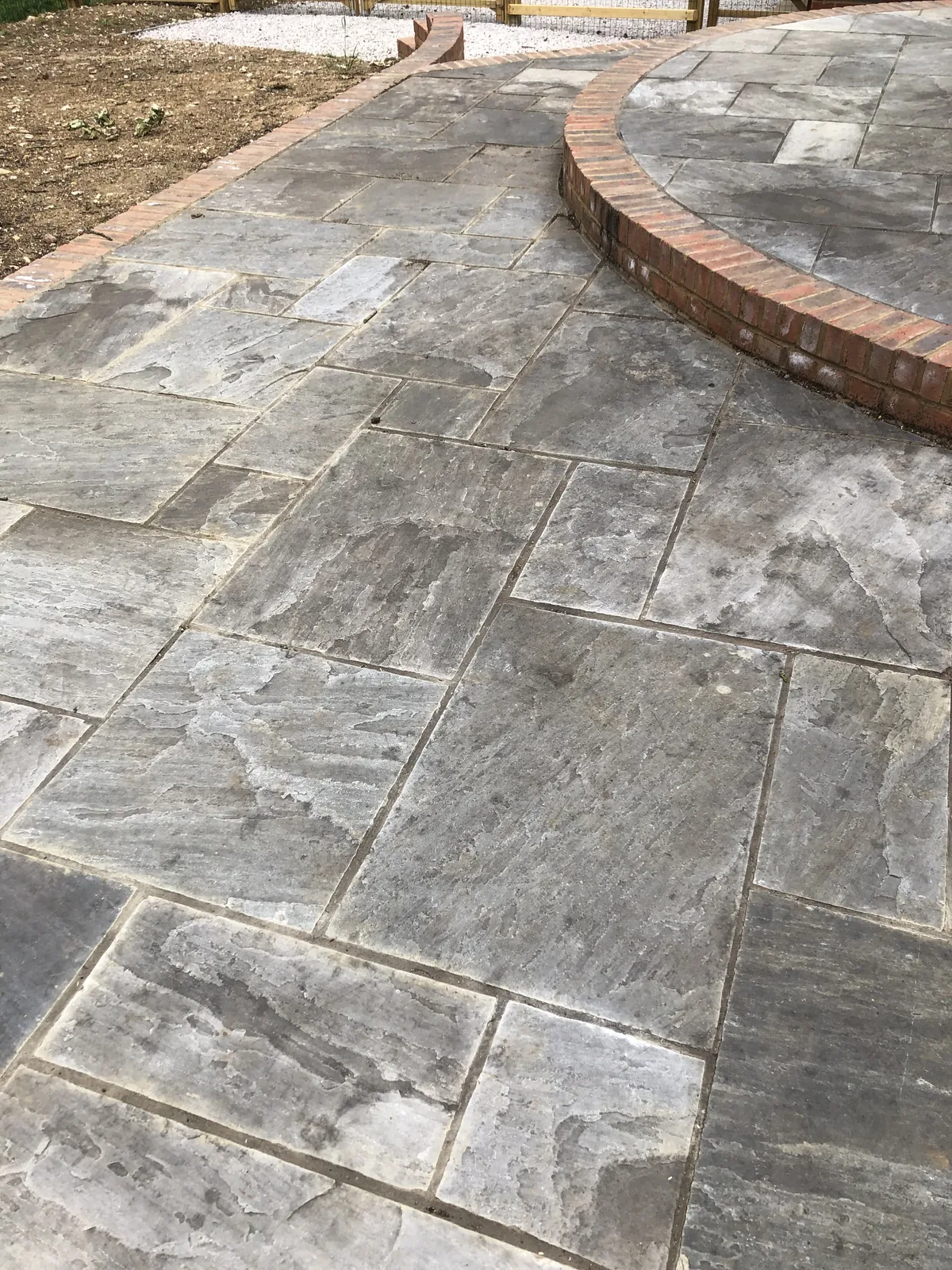
The paving is riven natural stone in random-coursed sizes, which has to be laid the way it looks best rather than the way it comes off the pallet: joints staggered, larger pieces kept where the eye lands, colours mixed across the whole area instead of ending up in patches. Beyond it, a raised circular terrace is ringed in a full circle of brick-on-edge.
Brick used as a drawing tool
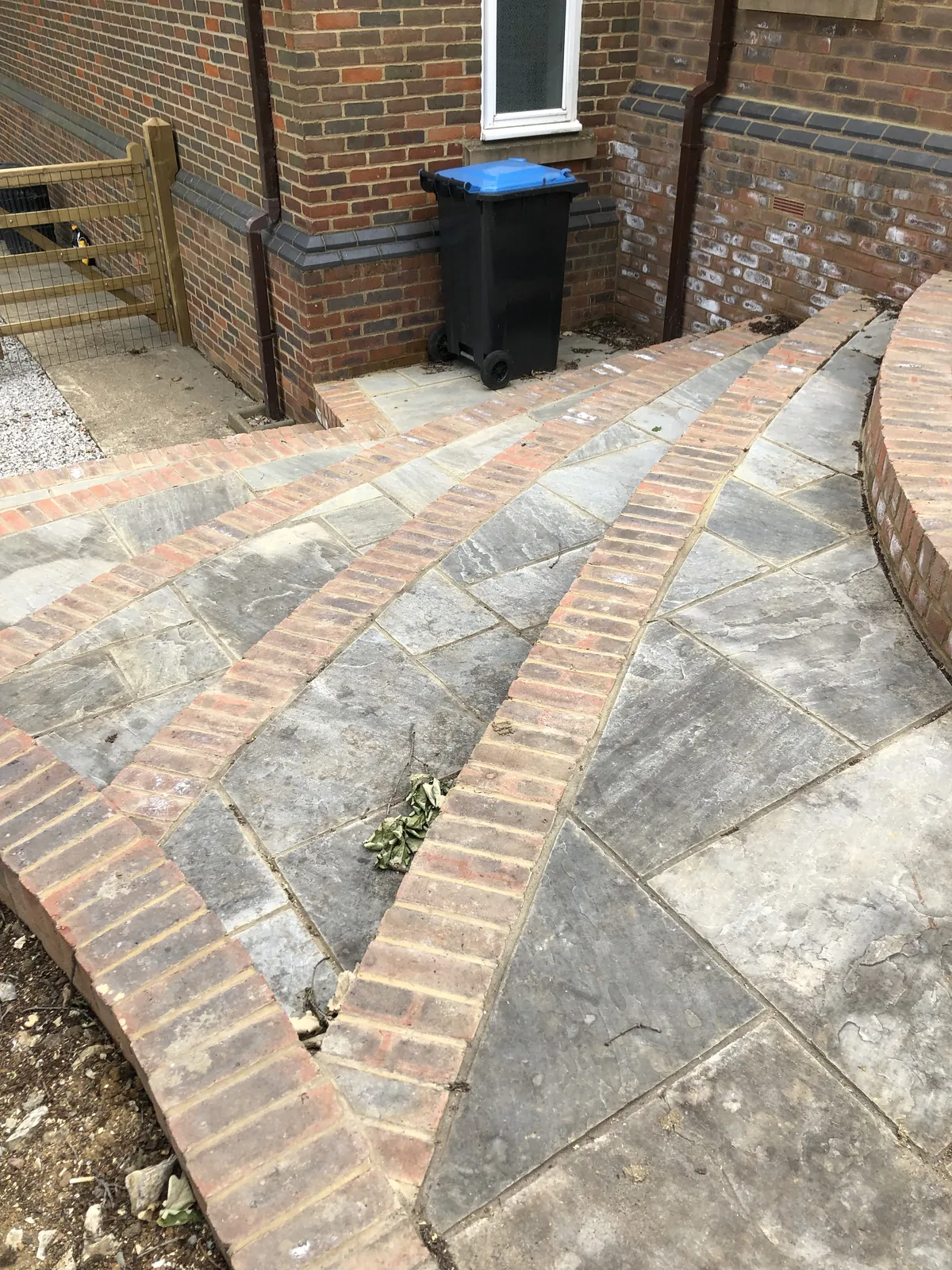
Where the paving has to turn the corner of the house, bands of brick fan out through the stone. That is doing real work as well as looking well: fanning the brick absorbs the change of direction, so the stone can stay in whole, generous pieces instead of being cut into ever-thinner wedges as it goes round.
It also ties the ground back to the house, because it is the same brick. Detailing like this is why we keep bricklaying and landscaping under one roof rather than treating the garden as somebody else's problem once the building is finished.
What this job is worth knowing about
- A sloping garden is groundwork. Levels, retaining and drainage first; the paving is the last thing that happens, not the first thing to think about.
- Curves are laid, not drawn. They are set out on site and built out of short straights, and they take time.
- Brick can solve what stone cannot. Banding turns a corner without reducing the stone to slivers.